
Be The Fool
On embracing a maverick mindset


Our society celebrates experts. The ones with all the answers.
In school, the eager kid whose hand shoots up like a rocket because he knows the capital of Oman gets a gold star.
In the workplace, the employee who intones smart-sounding phrases in meetings like “let’s take a step back” or “this won’t scale” gets a promotion.
Eventually, people learn that even if they don’t know the answer, they just need to act and talk like they do with a lot of bravado and confidence. When appearances are more than half the battle, you “fake it till you make it,” as they say.
We’re conditioned through most of our life to act like experts. Only, there’s a problem with expertise: it’s closed.
When you already know the fastest way to go from Point A to Point B, your path is fixed. You don’t explore other untested, unproven paths. Perhaps you no longer even see that other paths exist. Your field of view is narrowed.
“Innovation” is a big buzz word on many leaders’ lips these days. Yet few take the time to deeply understand what is required for innovation to flourish. It’s not expertise. Quite the opposite, actually. It’s openness. It’s curiosity, inquiry and spontaneity.
The expert may bring a lot of value to the table. But sometimes, the one who comes from a place of not knowing the answers can have just as much, if not more, to offer.
In the Tarot, the first card of the deck is The Fool. The number of The Fool is “0” because it is a wildcard. The Fool is a maverick.
Versions of the Tarot dating back to the 15th century have depicted The Fool as a vagabond with a stick slung over one shoulder. Some images, like the one below, show them (the gender is often ambiguous) strolling towards the edge of a cliff that they do not appear to see.
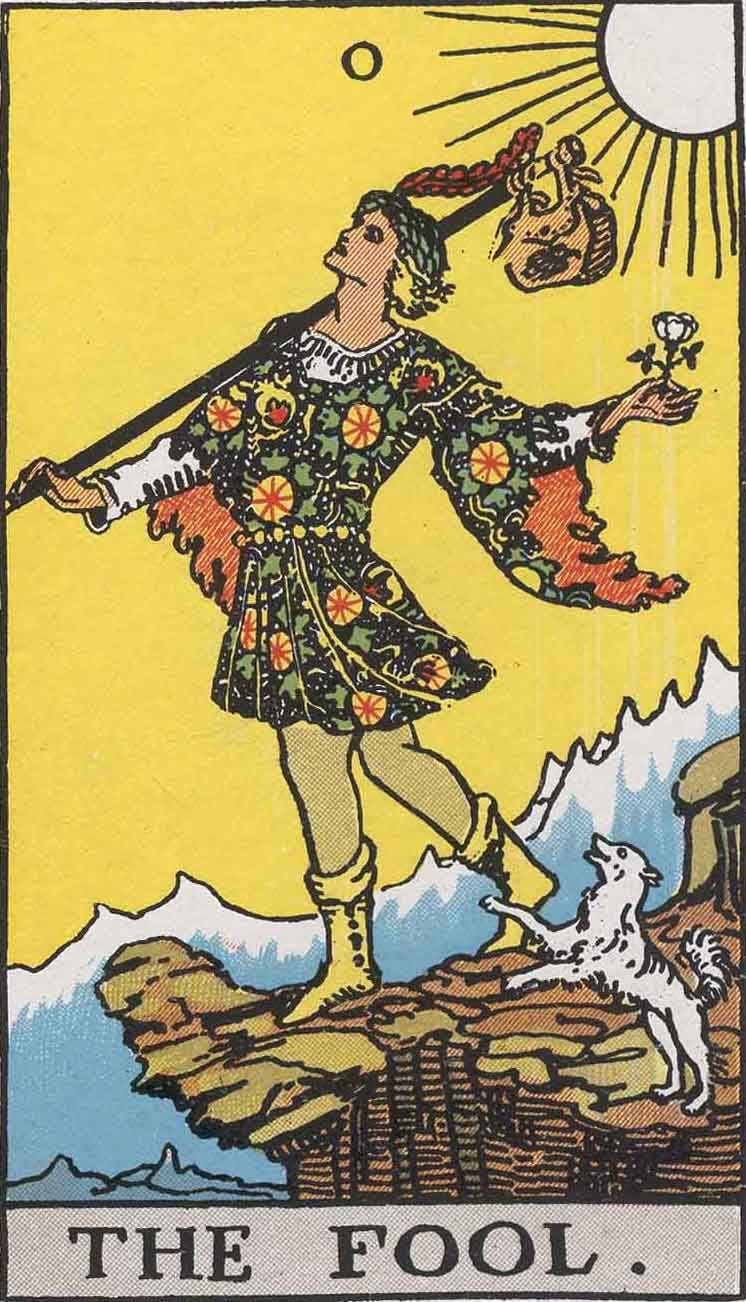
Indeed, it’s foolish to not look where one is going. But what if the flaw of the fool is also their strength? In Tarot readings, The Fool is often interpreted as the card of new beginnings and boundless possibility. It signifies a fearless leap into the unknown.
When you are a wildcard, you are a blank slate. You can do anything, or become anyone.
This was the same idea the Japanese Zen monk Shunryu Suzuki was attempting to convey when he emphasized the concept of “beginner’s mind.”
“If your mind is empty, it is always ready for anything, it is open to everything. In the beginner's mind there are many possibilities, but in the expert's mind there are few.”
-Shunryu Suzuki, Zen Mind, Beginner’s Mind
Beginner’s mind is empty mind, and in the best possible way. To be empty is to be unconstrained. In that open, formless space, there is room for creativity to breathe and for insight to arise.
So the next time you walk into a meeting or a brainstorming session, remind yourself that you don’t have to be that guy. The one with all the answers. You don’t have to fake anything. Just be authentically open and curious. Ask silly questions.
Expertise is overrated.
More often than you might imagine, it pays to be The Fool.
1️⃣ Albert Camus’s Beautiful Letter of Gratitude to His Childhood Teacher After Winning the Nobel Prize
The Marginalian
Who have you sent a thank you note lately? Just three days after winning the Nobel Prize in Literature, Albert Camus sent his childhood schoolteacher this heartwarming letter of gratitude. Perhaps it’ll inspire you to find somebody to thank today.
2️⃣ How to defuse catastrophic thoughts
Psyche
We live in uncertain times, and anxiety is on the rise everywhere. It’s useful to recognize when we or people around us are “catastrophizing” - fixating on the worst-case scenario - and to know how to steer thoughts in a more positive direction.
3️⃣ The Warren Buffet test to determine whether you live a blessed life
X (Formerly Twitter)
Warren Buffet (courtesy of Rob Henderson) suggests a great thought experiment for figuring out whether you might be lucky enough to live a “blessed” life.